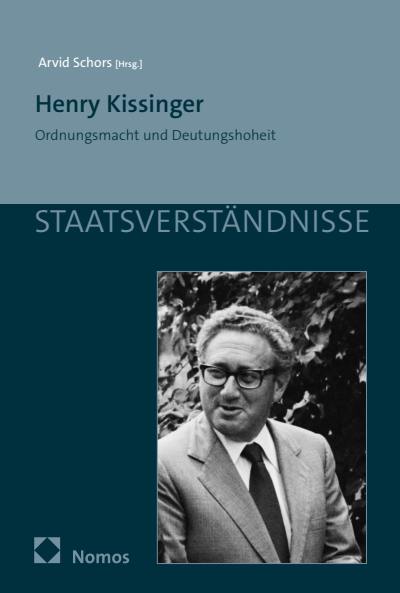
Henry Kissinger (1923-2023) is one of the most influential foreign policy figures of the 20th century. He shaped US top diplomacy from 1969 to 1977 as National Security Advisor and Secretary of State. A polarising figure throughout his life, he remains an important point of reference in foreign policy matters even beyond his death. As a professor and distinguished author on international politics, he also exudes the aura of a profound thinker. This volume examines Kissinger as a historical figure to critically analyse the diverse dimensions of his life and work. A focus is also placed on his relationship to Europe and Germany – his country of birth, from which he had to escape in 1938. With contributions by Martin Deuerlein | Anna Karla | Barbara Keys | Holger Klitzing | Klaus Larres | Constantin M. März | Arvid Schors | Christopher Seiberlich | Daniel Stahl
Keywords
Search publication
Bibliographic data
Copyright year
2025
ISBN-Print
978-3-7560-1021-9
ISBN-Online
978-3-7489-4710-3
Publisher
Nomos, Baden-Baden
Series
Staatsverständnisse
Volume
189
Language
German
Pages
248
Product type
Edited Book
Table of contents
ChapterPages
Editorial No access
Editorial – Understanding the State No access
Arvid Schors
Henry Kissingers transatlantische Relevanz No access
Ordnungsmacht No access
Deutungshoheit No access
Beziehungsebenen: US-Staatsmacht, Europa und „personal diplomacy“ No access
Henry Kissingers Regierungskarriere (1969-1977): Präsidentschaften und Politikfelder No access
Zur Struktur des Bandes No access
Barbara J. Keys
Woher der Ruhm? No access
Super K: Der vollendete Stratege No access
Evil K: Kriegsverbrecher (oder Sowjetagent?) No access
Schlussbetrachtung No access
Anna Karla
Wer schreibt, der bleibt: Kissingers Textproduktion No access
Handelt, wer schreibt? Kissinger macht Geschichte No access
Handlungsträger No access
Handlungsspielräume No access
Beobachtungsposten No access
Kommentator am Beckenrand: Geschichte nach Kissinger No access
Martin Deuerlein
Wissenschaft und Weltpolitik im Zeichen der „Pluralisierung“ No access
Kissinger und das Ende der Nachkriegszeit No access
Kissinger und die „erste Ölkrise“ No access
Project Interdependence: Das transatlantische Bündnis No access
Eine Neue Weltwirtschaftsordnung: Der „Globale Süden“ No access
Kissingers „Strategie der Interdependenz“ No access
Schluss No access
Constantin M. März
Vorspiel 1953-1957: „Massive Vergeltung“ und massive Kritik No access
„Nuclear Weapons and Foreign Policy“: Narrative, Thesen und Selbstdarstellung No access
„Nuclear Weapons and Foreign Policy“: Rezeption und Kontextualisierung No access
Kissinger und die nukleare Frage während seiner Regierungsjahre 1969-1977 und danach No access
Zusammenfassung No access
Daniel Stahl
Waffen für Diktatoren? No access
Die Verstrafrechtlichung der Menschenrechte No access
Schluss No access
Arvid Schors
Kindheitserfahrungen in Weimar und im nationalsozialistischen Deutschland – Erklärung für Kissingers Politikverständnis oder „not a key to anything“? No access
„Men of ideals are very rarely men of action.“ Kissingers Lehren aus seiner Zeit als US-Besatzungssoldat in Deutschland No access
Schlussbetrachtung No access
Holger Klitzing
Biographische Wurzeln, politische Philosophie und Deutschlandbild No access
1950 bis 1969: Deutschlandpolitik als Kern der US-Europapolitik No access
1969 bis 1976: Wechselwirkungen zwischen Bonns „neuer“ Ostpolitik und Washingtons Détente No access
1977 bis 2003: Stabile Koordinaten – der elder statesman und die deutsche Frage No access
Fazit: Die deutsche Frage als Problem internationaler Stabilität No access
Christopher Seiberlich
Außenpolitische Aufbrüche auf beiden Seiten des Atlantiks No access
Den Vietnamkrieg beenden: Verurteilung, Versöhnung und Vermittlung No access
Die Weltwirtschaft neu ordnen: Deutungshoheit und Durchschlagskraft No access
Fazit No access
Klaus Larres
Kissingers frühe Jahre No access
Der drohende Niedergang der USA No access
Transatlantische Beziehungen und europäische Integration No access
Ein neuer transatlantischer Ansatz und mangelndes Verständnis für die EG No access
Tiefe Differenzen über die transatlantische Geldpolitik No access
Camp David am 15. August 1971 und das Ende von Bretton Woods No access
Das Smithsonian-Abkommen und sein Scheitern No access
Der Wendepunkt des Jahres 1973 No access
Ausblick No access
Autorinnen und Autoren No access Pages 245 - 248
Similar publications
from the topics "Peace Research & Conflict Research", "Political Theory", "History General", "Comparative Political Research & Country Studies"