Your institution does not yet own a licence for this publication. You can .
Book Titles No access
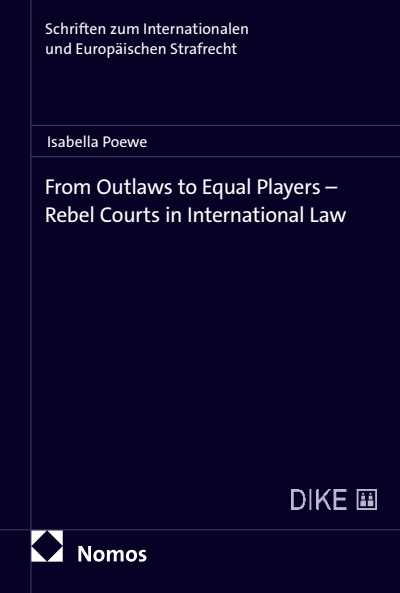
From Outlaws to Equal Players – Rebel Courts in International Law
- Authors:
- Series:
- Schriften zum Internationalen und Europäischen Strafrecht, Volume 82
- Publisher:
- 2026
Summary
Can rebel courts be lawfully established under international humanitarian law? Should their decisions be recognized within the principle of ne bis in idem according to international criminal law? By assessing these questions, the thesis undertakes a shift in perspective: So far, non-state armed groups and their representatives have primarily been regarded as potential perpetrators of international crimes, often committed during armed conflict. However, this book assesses and demonstrates that they can also be considered as euqal players in the enforcement of international criminal law during armed conflict.
Keywords
Search publication
Bibliographic data
- Copyright year
- 2026
- ISBN-Print
- 978-3-7560-3437-6
- ISBN-Online
- 978-3-7489-6461-2
- Publisher
- Nomos, Baden-Baden
- Series
- Schriften zum Internationalen und Europäischen Strafrecht
- Volume
- 82
- Language
- English
- Pages
- 288
- Product type
- Book Titles
Table of contents
ChapterPages
- Acknowledgements No access
- List of Abbreviations No access
- I. Aim and Structure of the Book No access
- II. Focus of Research and Basic Assumptions No access
- 1. Non-state vs. state No access
- 2. Armed vs. non-armed No access
- 3. Group vs. individual No access
- a. National liberation movements No access
- b. De facto entities No access
- c. Insurgents No access
- d. Militias No access
- e. Terrorist groups No access
- f. Organized criminal groups No access
- 5. Conclusion No access
- 1. Rebel governance: conceptual clarifications No access
- 2. Rebel governance and the aim of legitimacy No access
- 3. Conclusion No access
- 1. Insurgent judiciary in theory No access
- aa. Background of the conflict No access
- bb. The FMLN’s judicial system No access
- aa. Background of the conflict No access
- bb. The FARC’s judicial (governance) system No access
- aa. Background of the conflict No access
- bb. The LTTE’s judicial system No access
- aa. Background of the conflict No access
- bb. The PYD/YPG’s judicial system No access
- e. Interim conclusion No access
- 3. Conclusion No access
- 1. Definition according to Common Article 3 to all four Geneva Conventions of 1949 No access
- a. Responsible command No access
- b. Territorial control No access
- c. Sustained and concerted military operations No access
- d. Capacity to implement the Protocol No access
- e. Not internal disturbances and tensions No access
- 3. Definition according to the Tadić-formula of the ICTY No access
- a. Textual interpretation of Art. 8 (2)(d) and (f) ICC Statute No access
- b. Historical interpretation of Art. 8 (2)(d) and (f) ICC Statute No access
- c. Customary status of Art. 8 (2)(c) and (e) ICC Statute No access
- 5. Conclusion No access
- a. Ad hoc regulation trough the concepts of rebellion, insurgency and belligerency No access
- b. Development of a systematic IHL applicable to NIACs prior to 1949 No access
- a. Common Article 3 to all four Geneva Conventions of 1949 No access
- b. Additional Protocol II No access
- c. Additional treaty law applicable to NIACs No access
- d. Customary IHL applicable in NIACs No access
- 3. Conclusion No access
- I. Scope of IHL Provisions Relating to the Administration of Justice by NSAGs No access
- a. ‘regularly constituted’ No access
- b. ‘judicial guarantees which are recognized as indispensable’ No access
- c. A fit for purpose definition of ‘regularly constituted court’ No access
- a. ‘Established by (state) law’: traditional state-centricity in international law No access
- b. ‘Established by (non-) state law’? No access
- 3. Conclusion No access
- a. ‘Independence and impartiality’ No access
- b. Judicial guarantees of Art. 6 (2)(a)-(f) Additional Protocol II No access
- a. Courts of NSAGs during armed conflict: a capacity problem No access
- b. Towards substantive equality: seeking a differentiated solution No access
- 3. Conclusion No access
- a. The nature of norms No access
- b. The nature of Common Article 3 and Art. 6 (2) Additional Protocol II No access
- 2. Resolving a misconception: relative legality No access
- V. Factual Parameters for the Legality of Courts of NSAGs No access
- VI. Conclusion No access
- 1. Ne bis in idem in human rights law No access
- 2. Ne bis in idem as a national (criminal law) guarantee No access
- a. Art. 4 Protocol 7 additional to ECHR No access
- b. Art. 50 EUCFR No access
- c. Art. 54 CISA No access
- 4. Ne bis in idem in IHL No access
- 5. Conclusion No access
- a. Structure of Art. 17 ICC Statute No access
- aa. Inactivity No access
- bb. ‘Unwilling or unable genuinely to investigate and prosecute’ No access
- cc. ‘Sufficient gravity’ No access
- 2. The admissibility-regime and its relation to the ne bis in idem principle No access
- 3. Conclusion No access
- a. Textual interpretation No access
- b. Contextual interpretation No access
- c. Teleological interpretation No access
- d. Historical interpretation No access
- e. Equality of belligerents No access
- f. Thinking command responsibility pursuant to Art. 28 ICC Statute further No access
- g. Return to ne bis in idem as a human right No access
- h. Interim conclusion No access
- 2. Final conviction or acquittal No access
- 3. ‘shall be tried by the Court with respect to the same conduct’ No access
- 4. Conclusion No access
- 1. The ICC and the administration of justice by non-state entities: an extract No access
- a. Normative requirements No access
- b. Factual parameters No access
- c. Examination process: a proposal No access
- 3. Conclusion No access
- Chapter 6: Summary and Conclusions No access Pages 257 - 262
- References No access Pages 263 - 288