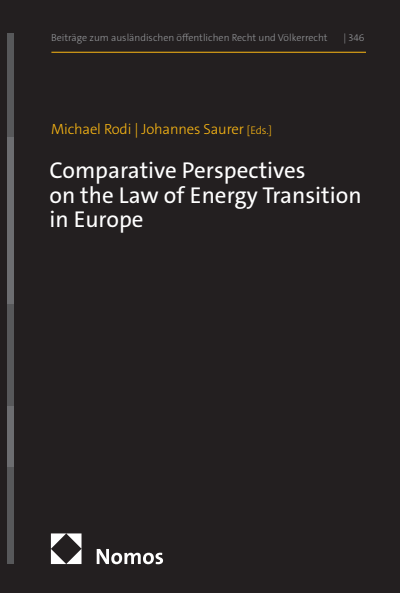
Comparative Perspectives on the Law of Energy Transition in Europe
- Herausgeber:innen:
- |
- Reihe:
- Beiträge zum ausländischen öffentlichen Recht und Völkerrecht, Band 346
- Verlag:
- 2025
Zusammenfassung
Die Energietransformation stellt die staatlichen Rechtsordnungen vor so noch nicht dagewesene Herausforderungen. Ohne systematische Rechtsvergleichung als Grundlage für ein Lernen voneinander werden die nationalen Gesetzgeber diese nicht bewältigen. Vor diesem Hintergrund präsentiert das vorliegende Werk eine Rechtsvergleichung zur Energietransformation in Europa allgemein sowie mit einem speziellen Fokus auf das Recht der Erneuerbaren Energien. Untersucht wurden dazu die Rechtsordnungen von Dänemark, Deutschland, Frankreich, Italien, Polen und Schweden für den Bereich der Europäischen Union sowie das Vereinigte Königreich als früheres Mitglied der EU und wichtiger Wegbereiter des Energiewende- und Klimarechts.
Mit Beiträgen von Prof. Helle Tegner Anker | Agnieszka Ason | Prof. Dr. Michael Fehling, LL.M. (Berkeley) | Asso. Prof. Louis de Fontenelle | Prof. Fabrizio Fracchia | Prof. Bent Ole Gram Mortensen | Dr. Aleksandra Knap | Prof. Marie Lamoureux | Asso. Prof. Melina Malafry | Ass. Prof. Chiara Mari | PD Dr. Till Markus, LL.M. | Kate McKenzie, PhD | Prof. Dr. Michael A. Mehling, LL.M. | Dr. Bartłomiej Nowak | Asso. Prof. Sirja-Leena Penttinen | Prof. Dr. Johann-Christian Pielow | Prof. Dr. Michael Rodi, M.A. | Prof. Dr. Johannes Saurer, LL.M. (Yale) | Prof. Kim Talus
Schlagworte
Publikation durchsuchen
Bibliographische Angaben
- Copyrightjahr
- 2025
- ISBN-Print
- 978-3-7560-3326-3
- ISBN-Online
- 978-3-7489-6260-1
- Verlag
- Nomos, Baden-Baden
- Reihe
- Beiträge zum ausländischen öffentlichen Recht und Völkerrecht
- Band
- 346
- Sprache
- Englisch
- Seiten
- 449
- Produkttyp
- Sammelband
Inhaltsverzeichnis
- Contributors
- Johannes Saurer, Michael Rodi Download Kapitel (PDF)
- Section A: EU Law Framework for Energy Transition
- Section B: General Perspectives on the Law of Energy Transition
- Section C: Special Focus: Law of renewable energy expansion in comparative perspective
- Michael Rodi Download Kapitel (PDF)
- A. Climate and Energy Transformation Law as Objects of Comparison within the European Union
- 1. International Energy Law
- 2. International Climate Law
- C. Competences of the European Union
- D. EU Climate and Energy Transformation Policy
- 1. General Climate Targets
- 2. Targets for Renewables
- 3. Energy Efficiency Targets
- F. Overall Energy and Climate Governance
- 1. Emission Mitigation
- 2. Renewable Energy Law
- 3. Energy Efficiency Law
- 4. Further Net-Zero Technologies
- H. Conclusions
- Johannes Saurer Download Kapitel (PDF)
- A. Introduction
- B. Definitions and Empirical Development
- C. EU Competences for Renewable Energy Policy
- D. EU Renewable Energy Targets
- E. Requirements of the Regulation on the Governance of the Energy Union and Climate
- F. EU Law Requirements for Planning and Permit-Granting Procedures for Renewable Energy Installations in EU Member States
- G. EU Law Requirements for National Support Schemes
- H. Infrastructure Dimension
- I. Conclusion
- Kim Talus, Sirja-Leena Penttinen Download Kapitel (PDF)
- A. Introduction: New Sustainable Fuel Targets
- (a) RFNBO under EU law
- (b) Qualification of Electricity from a Direct Connection With an Installation Generating Renewable Electricity as Fully Renewable
- (c) Qualification of Electricity Taken from the Grid as Fully Renewable
- (d) Additional Requirements of Additionality Temporal and Geographic Correlation
- 1. Electrofuels
- 2. Recycled Carbon Fuels
- 3. Biofuels Under the Renewable Energy Directive of 2023
- D. Discussion – Future Uncertainties
- Michael A. Mehling Download Kapitel (PDF)
- A. Introduction
- B. The Rise of Green Industrial Policy
- (a) Background and Context
- (b) Central Features of U.S. Green Industrial Policy
- (c) Assessment
- (a) Background and Context
- (b) Central Features of EU Green Industrial Policy
- (c) Assessment
- D. Conclusions
- Till Markus Download Kapitel (PDF)
- A. Introduction
- B. The Transformation of the German Energy Mix
- 1. Historical Developments
- (a) Constitutional Objectives and Obligations
- (b) Division of Legislative Powers
- 3. Actors and their Interests
- D. (Moving) Targets for the Energy Transition and Key Implementation Challenges
- E. Nuclear Exit
- F. Coal Phase-Out
- G. Oil & Gas
- H. Promoting Renewable Energy
- I. Sector-coupling: the example of hydrogen
- J. Conclusions
- Marie Lamoureux Download Kapitel (PDF)
- A. Introduction
- B. The French Legal Framework for the Energy Transition
- C. The Path Towards Decreasing the Production and Consumption of Fossil Fuels
- D. Efforts To Improve the Development of Renewable Energies and Energy Savings
- E. The Continuing Central Role of Nuclear Energy
- F. Conclusion
- Fabrizio Fracchia Download Kapitel (PDF)
- A. Some Data about the Current National Energy Mix
- B. Policies and Strategies Envisaged by Italy
- C. The Legal Tools (Command and Control, Market-Based Tools) and the Public Interests that are Involved in the Transition
- 1. The First Part of the Definition: the Transition as a “Form of a Function”
- 2. The Second Part of the Definition: Setting the Problem, Considering Energy Transition, Structural Change in Society, Stop and Go, Multilevel Approach, Intergenerational Relations, Connections with Other Problems of Modernity
- 3. The Third Part of the Definition: The Transition as a Form of Fulfilment of (Common but Differentiated) Intergenerational Duties
- E. Concluding Remarks
- Chitzi C. Ogbumgbada, Kate McKenzie Download Kapitel (PDF)
- A. Introductory Comments
- 1. Scope of the UK’s NDC
- 2. The Energy Act (2023)
- C. The National Energy Mix
- D. Trade-offs and the Energy Transition in the UK
- E. Concluding Remarks
- Bent Ole Gram Mortensen Download Kapitel (PDF)
- A. More Recent Historical Overview
- B. The Current Energy Supply and Policy
- 1. Production
- 2. Consumption
- D. Electrification
- E. Heating of Buildings
- F. Biomass
- 1. Offshore
- 2. Onshore
- 1. Nature Protection
- 2. CCU or CCS
- 3. Local Communities
- I. Conclusion
- Melina Malafry Download Kapitel (PDF)
- A. Introduction
- B. Energy Mix and Current Energy Goals in Sweden
- C. Historical and Political Background
- D. Laws Enabling the Transition from Fossil Fuels
- E. Renewables in the Electricity System – Political Goals and Predictions
- 1. Municipal Planning Monopoly in Sweden
- 2. Legal framework in the energy transition and the land and environmental courts
- 1. Introduction
- (a) The Permit Procedure of Wind Power – General Conflicts Over Land and Water Areas
- (b) NIMBY and the Municipal Veto
- (a) Introduction
- (b) Photovoltaics on Buildings
- (c) Large-Scale Photovoltaic Parks
- 4. Hydropower
- 5. Access to Grid Infrastructure
- H. Conclusion and Way Forward
- Bartłomiej Nowak, Aleksandra Knap Download Kapitel (PDF)
- A. Introduction
- B. The National Notion of Energy Transition
- C. Decarbonization Strategy
- D. The National Energy Mix in the Context of the Energy Transition
- E. Power-to-X Technologies – Alternative Energy Sources – Hydrogen
- F. Perspectives of Energy Transition in Poland
- G. Summary
- Michael Fehling Download Kapitel (PDF)
- A. Empiric development: growing gap between official policies (goals) and reality
- B. Current challenges and obstacles for the expansion of renewables
- 1. Preliminary remark on the distribution of competences between the federal government, the states and the municipalities
- (a) Decarbonization of electricity production
- (b) New refinancing system
- (c) Complex interaction of subsidizing renewables and emission trading
- 3. Securing sufficient area for onshore wind energy development
- 4. Consequences of the expansion of renewable energies for the (grid) infrastructure
- 1. High investment risk for preparing participation in the tendering process for a market premium
- 2. Slow grid extension and modernization
- 3. Unsolved storage problems in view of the volatility of wind power and solar energy
- 4. Insufficient amount of green power and hydrogen in light of increasing demand due to sector coupling
- E. Conclusion
- Louis de Fontenelle Download Kapitel (PDF)
- A. Introduction
- B. Definition of Renewable Energies
- 1. Provisions Common to Renewable Energies Under French Law
- (a) The Development of the Law Prior to the APER Act
- (b) The APER Act of 2023
- 1. National Planning
- 2. Local Planning
- 3. Renewable Energy Acceleration Zones
- 1. Landscape Integration of Renewable Energy Projects
- 2. The Concept of Territorial Value-Sharing Introduced by APER Law
- 3. Litigation
- 1. Feed-in Tariffs and Feed-in Premium
- 2. Long-Term Sales Contracts
- 3. Self-consumption and energy communities
- G. Administrative Simplification
- H. Conclusion: The Complexity of the Law and the Risk of a Deterioration in the Quality of Standards
- Chiara Mari Download Kapitel (PDF)
- A. Energy transition in Italy: concept, objectives, tools and challenges
- B. Authorization procedures: rules and problems in a public multilevel administration
- C. The relevance of private activity
- D. The use of guidelines, soft law, and the reduction of information asymmetries
- E. The social consensus on projects and the deflation of litigation
- F. Concluding remarks
- Agnieszka Ason Download Kapitel (PDF)
- A. Introduction: the UK’s Path to Net Zero
- 1. The Mechanism
- 2. Renewable Power Generation
- (a) Hydrogen
- (b) Carbon Capture and Storage
- (c) Multi-technology Schemes
- C. Contracts for Difference in Other Jurisdictions: Comparative Perspectives
- D. Conclusions and Outlook
- Helle Tegner Anker, Bent Ole Gram Mortensen Download Kapitel (PDF)
- A. Introduction – Targets and Results
- 1. Introduction
- (a) Onshore
- (b) Offshore
- (a) Onshore
- (b) Offshore
- 4. Compensation Schemes
- (a) Onshore
- (b) Offshore
- 2. Nature Protection and Biodiversity
- 3. Grid connection and capacity
- D. Conclusion
- Johann-Christian Pielow, Kate McKenzie Download Kapitel (PDF)
- 1. The Benefits of Comparative Legal Analysis
- 2. “Proper” Comparative Legal Analysis
- 3. Further Approach
- 1. Understanding of “energy transition”
- 2. Target hierarchies and conflicts / trade-offs
- (a) Timelines of energy transition
- (b) (Path) Dependencies of multiple preconditions
- (aa) Expansion paths for RE
- (bb) Energy efficiency
- (d) (Other) Innovative technologies
- 3. Interim conclusion
- (a) Transition “planning”
- (b) Statutory law
- (a) Set of measures between the state and the market
- (aa) Increasing competition
- (bb) Planning and social acceptance
- (cc) Interim conclusion
- (c) Role of public companies
- (a) Energy infrastructure between climate and (other) environmental law
- (b) Confusion and conflicts over responsibilities
- (c) Energy transition and the money
- D. Outlook / lessons to be learnt